怎么玩
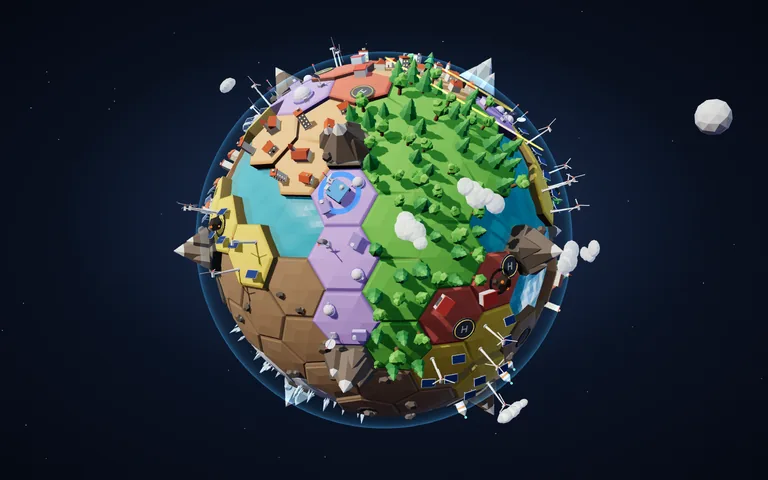
每家公司都拿到同一颗星球的副本:一颗由 150 个六边形格子组成的小星球,另有 12 座山峰(球面上必须有的 12 个五边形,不能放板块),两极有冰盖,地面上散落着 6 个救生舱。每轮你从空间站上拿一块地形板拼到自己的星球上,板上的两种地形各推进对应的轨道一格。轨道会给你文明卡、协同推进、生物补丁、探测车、科技和奖章。游戏结束时奖章最多的公司获胜。
一轮怎么走
- 站长转动空间站。空间站有 6 个仓位,每个仓位放着一叠小板(内圈)和一叠大板(外圈)。每个人只能从自己面前的仓位拿板,所以站长转到哪里,就决定了谁能拿到什么。站长每轮轮换,名字旁边有星标。
- 拿一块板。从面前的两块里选一块。只要有一块放得下,就必须选放得下的那块。
- 拼到星球上。第一块随便放,之后每块都要和你已有的地块边贴边,不能重叠,也不能压在山峰上。可以按 60° 旋转。盖住救生舱或探测车会把它们压毁。
- 推进轨道。板上两种地形各推进一格。水要盖到冰上才算数;能源没有自己的轨道,可以换成板上另一种资源,或紧挨着能源格的已有地形。
- 领取奖励。轨道走到有图标的格子,就领取那一格的奖励,比如选一张文明卡、派出探测车、开车、放一块补丁。
五条轨道
- 文明(橙):第 2、5、9、13 格各给一张 I、II、III、IV 级文明卡。卡有两种:立即生效的(任选轨道前进、探测车开几步、拿补丁、科技前进)和终局计分的(按最大水域、森林、城区,完整环带,铺满的大区等加分)。每级卡数量有限,先到先挑。
- 水(蓝):奖章最多的轨道,满格 13 枚,还有三次协同推进(任选一条轨道前进一格)。只有水地形盖到冰的时候才会前进。
- 生物(绿):每隔一两格给一块生物补丁:1 格的森林,能填缝、补全环带,但不推进轨道。
- 探测(红):第 1、6 格各派出一辆探测车,降落在你最新放下的板块上;其余格子让探测车走 2 到 6 步。到顶以后每次再推进都能走 6 步。
- 科技(紫):依次解锁五项科技:自由着陆(新板块不必挨着已有地块)、种子库(补丁可以先存着)、涡轮驱动(探测车每次多走 1 步)、融冰工程(水轨一次前进 2 格)、陨石护盾(不再落陨石)。
每条轨道终局按走到的最高奖章计分。轨道一共 15 格,一局大约 30 轮,不可能五条都走满,要有取舍。
陨石、救生舱和探测车
- 有些板块带陨石标记,放下时陨石会砸在那一格上。有陨石的格子会挡住它所在的环带,直到探测车把陨石运走;收集的陨石每 3 块算 1 分。
- 救生舱散落在星球的空地上,探测车开过去就能救回,每个 +2。用板块盖住它就救不回来了。
- 探测车可以在任何格子上开(山峰除外),步数可以分给两辆车。别把板块压在自己的车上。
环带
从北极到南极,格子排成 11 条绕星球一圈的环带:两极旁的环带 5 格,往赤道走依次是 10 格、15 格,赤道附近是 20 格(有两条环带上各有 5 座山峰,只算剩下的 15 格)。一条环带全部铺满、上面没有陨石,就算完成,终局按长度得分:5 格 +1、10 格 +2、15 格 +3、20 格 +4,星球上会亮起一圈金色光环。鼠标停在格子上,会显示它所在的环带已经铺了多少。
结束和计分
有人面前的两块板都放不下,或者某个仓位被拿空,那一轮结束后游戏结束。终局计分:完整环带按长度每条 1 到 4 分、五条轨道各自的奖章、救生舱每个 2 分、陨石每 3 块 1 分、终局文明卡,以及和左右邻座比拼的目标(比如环带更多、最大森林更大、空格更少,赢了或打平各 +5)。平分时空格少的赢。
电脑对手和单人挑战
可以和一到三家电脑公司比拼,难度有简单、普通、困难:简单的会犯错,困难的当站长时还会把空间站转到让领先者难受的位置。单人挑战时空间站每轮自动转一格,给你三个私人目标,目标是拿到 80 枚奖章。
操作方式
- 拖动转动星球,滚轮或双指缩放。
- 选好板以后,板块的虚影会跟着鼠标;R 或右键顺时针转 60°,Q 逆时针。虚影变红就是放不了,下面会写原因。
- 1 / 2 选板,← → 和 Enter 转动空间站,H 打开规则,Esc 打开菜单。
- 点左边的公司卡片,可以看对手的星球;右边是你的五条轨道、科技、文明卡和目标。
- 手机上点一下格子先预览,再点「放在这里」确认;右下角的按钮打开轨道面板。
几个小技巧
- 冰是有限的:水板尽量盖在冰上,别用其他地形把冰盖掉。
- 留意单格的空洞,只有生物补丁才填得上。
- 早点派出探测车,陨石越晚运走,被挡住的环带越多。
- 当站长时,先看看转到哪个仓位对自己最好,再看看会给对手送什么。
常见问题
第一次玩从哪里开始?
主菜单里点「新手教程」:和一个简单的电脑对手打一局,第一轮你当站长,聚光框和提示会一步步带你转空间站、选板、拼板、看轨道和环带,做完一步自动进入下一步,随时可以跳过。
有声音吗?
有。菜单曲《新世界》,对局里随着星球铺满换成《荒原》《绿意》《环带》;完成环带、拿到文明卡、解锁科技、救回救生舱都有自己的乐句,转动空间站、板块落地(每种地形声音不同)、陨石撞击、探测车行驶也都有音效,还有星球上的风声。右上角可以关掉声音或音乐,主菜单里能调音量。
游戏会保存吗?
会。每一步都会记在当前浏览器里,刷新或关掉页面以后,主菜单里点「继续这一局」就能接着玩。
手机能玩吗?
能。不过屏幕越大,越容易看清整颗星球,电脑上玩最舒服。
英文能玩吗?
能。右上角切换中文和 English,游戏里的文字会一起切换。
版本说明
2026-10-06 第三版:加入新手教程(13 步,跟着提示打一局)、四首背景音乐(菜单《新世界》,对局随进度换成《荒原》《绿意》《环带》)、十一个乐句和二十多种合成音效,以及星球上的风声。
2026-10-06 第二版:星球从立方体换成六边形格子,150 个六边形加 12 座山峰,格子都是正六边形;板块换成六边形拼块,可以按 60° 旋转;环带改成从北到南的 11 条,按长度计 1 到 4 分。
2026-10-06 首个版本:立方体星球上的 12 种板块、五条 15 格的轨道、五项科技、24 张文明卡、10 种邻座目标、陨石、救生舱和探测车,一到三家电脑公司(三档难度)或单人挑战,自动存档。星球、地形、建筑、探测车都是在网页里实时生成的低多边形 3D 模型。
How to play
Every corporation gets a copy of the same planet: a little planet of 150 hexagon cells plus 12 mountains (the twelve pentagons every hexagon sphere has, where no tile can go), with polar ice caps and six lifepods scattered on the ground. Each round you take a terrain tile from the space station and fit it onto your planet, and each of the tile's two terrains advances its track once. The tracks hand out civ cards, boosts, biomass patches, rovers, technology and medals. The corporation with the most medals at the end wins.
A round
- The commander turns the station. The station has six depots, each with a stack of small tiles (inner ring) and a stack of large ones (outer ring). Everyone may only take from the depot in front of them, so where the commander turns it decides who gets what. The commander changes every round and has a star by their name.
- Take a tile. Pick one of the two in front of you. If one of them fits on your planet, you must take one that fits.
- Lay it. The first tile goes anywhere; after that every tile must touch your land edge to edge, without overlapping or covering a mountain. Turn it in sixths of a turn. Covering a lifepod or a rover destroys it.
- Advance. Each of the tile's two terrains advances its track once. Water only counts if the water part covers ice. Energy has no track of its own: it advances the tile's other resource or the track of terrain right next to it.
- Collect. When a tracker lands on a step with an icon you get that reward: choose a civ card, deploy a rover, drive, place a patch and so on.
The five tracks
- Civ (orange): steps 2, 5, 9 and 13 give a rank I, II, III and IV civ card. Some cards help at once (advance a track, drive rovers, gain patches, advance tech); others score at the end (largest water, forest or city area, complete rings, fully covered regions and more). Each rank has only a few cards, first come first served.
- Water (blue): the richest track in medals, 13 at the top, plus three boosts (advance any track once). It only moves when the water part of a tile covers ice.
- Biomass (green): a biomass patch every step or two: a one-cell forest that fills gaps and completes rings but advances no track.
- Rover (red): steps 1 and 6 deploy a rover on the tile you just laid; the other steps let your rovers drive 2 to 6 cells. Past the top, every further advance gives 6 steps.
- Tech (purple): five technologies in order: free landing (new tiles need not touch your land), seed vault (keep patches for later), turbo drive (one more step each time rovers move), ice melt (water advances twice) and meteor shield (no more meteorites).
At the end each track scores the highest medal it has reached. Tracks are 15 steps long and a game lasts about 30 rounds, so you cannot fill all five: choose.
Meteorites, lifepods and rovers
- Some tiles carry a meteor mark: when laid, a meteorite lands on that cell. It blocks its ring until a rover hauls it away; collected meteorites score 1 per 3.
- Lifepods lie on empty ground; drive a rover over one to rescue it for +2. Cover it with a tile and it is lost.
- Rovers drive over any cell but the mountains, and you may split the steps between two rovers. Do not lay a tile on your own rover.
Rings
From pole to pole the cells form 11 rings round the planet: 5 cells by the poles, then 10 and 15, and 20 round the equator (two rings each hold 5 mountains and count their other 15 cells). A ring with every cell covered and no meteorite on it is complete and scores by its length at the end: 5 cells +1, 10 cells +2, 15 cells +3, 20 cells +4; a gold halo lights up round the planet. Hover a cell to see how full its ring is.
The end and scoring
The game ends after the round in which someone cannot lay either tile, or a depot runs dry. The count: 1 to 4 per complete ring by its length, each track's medals, 2 per lifepod, 1 per 3 meteorites, end-game civ cards, and objectives against your neighbours on each side (more rings, a larger forest, fewer empty cells and so on: +5 for winning or tying each). Ties go to fewer empty cells.
Computer rivals and solo play
Play against one to three computer corporations at easy, normal or hard: easy ones make mistakes, hard ones also turn the station against the leader when they are commander. In solo play the station turns by one depot each round, you get three private goals, and the target is 80 medals.
Controls
- Drag to spin the planet; wheel or pinch to zoom.
- Once you have taken a tile its ghost follows the pointer; R or right-click turns it a sixth clockwise, Q back. A red ghost cannot go there, and the reason is shown below.
- 1 / 2 take a tile, ← → and Enter turn the station, H rules, Esc menu.
- Click a corporation on the left to look at its planet; your tracks, technology, cards and objectives are on the right.
- On a phone, tap a cell to preview the tile, then tap Place here; the button at the bottom right opens your tracks.
Tips
- Ice is scarce: lay water on it, and avoid covering it with other terrain.
- Watch for one-cell holes: only a biomass patch can fill them.
- Deploy rovers early; the longer a meteorite stays, the more rings it blocks.
- As commander, look at what each turn gives you, then at what it hands your rivals.
FAQ
Where do I start the first time?
Press Tutorial in the main menu: one game against an easy computer rival, with you as the first commander. A spotlight and short notes walk you through turning the station, taking and laying tiles, the tracks and the rings; each step moves on once you have done it, and you can skip at any time.
Is there sound?
Yes. A menu theme, then three pieces in a match that change as your planet fills up; calls for a complete ring, a civ card, a technology and a rescued lifepod; effects for the station turning, tiles landing (each terrain sounds different), meteorite impacts and rovers driving, and wind over the planet. Turn sound or music off in the top right; set the volumes in the main menu.
Does the game save?
Yes. Every move is kept in this browser; after a reload or closing the page, press Continue in the main menu.
Can I play on a phone?
Yes, though a bigger screen shows more of the planet, so a computer is the most comfortable.
Is it in English?
Yes. Switch between Chinese and English in the top right; the game's text switches too.
Version notes
Third version, 2026-10-06: a 13-step tutorial game, four pieces of music (a menu theme, and three in a match that follow how covered your planet is), eleven calls, over twenty synthesized effects and wind over the planet.
Second version, 2026-10-06: the planet changes from a cube to hexagon cells, 150 regular hexagons and 12 mountains; tiles become polyhexes that turn in sixths; the rings become 11 from north to south, scoring 1 to 4 by their length.
First release, 2026-10-06: 12 tile shapes on a cube planet, five 15-step tracks, five technologies, 24 civ cards, 10 neighbour objectives, meteorites, lifepods and rovers, one to three computer corporations at three levels or solo play, and automatic saving. The planet, terrain, buildings and rovers are low-poly 3D models generated live in the page.